The decarbonisation of the Flemish building stock is an urgent yet complex challenge. Buildings account for a significant share of energy consumption and CO₂ emissions. Although Flanders is strongly committed to energy-saving measures and innovative construction and renovation technologies, their real-world performance often falls short of expectations. Weather conditions, execution details and occupant behaviour have a greater impact than calculations predict. To bridge the gap between research, industry and practice, ConstrucThor—a new Flemish test facility for climate-neutral construction—opens today at Thor Park Genk. ConstrucThor offers companies and industrial partners a unique environment to test, optimise and more rapidly valorise innovative construction and renovation solutions at full scale, accelerating their path to market deployment.
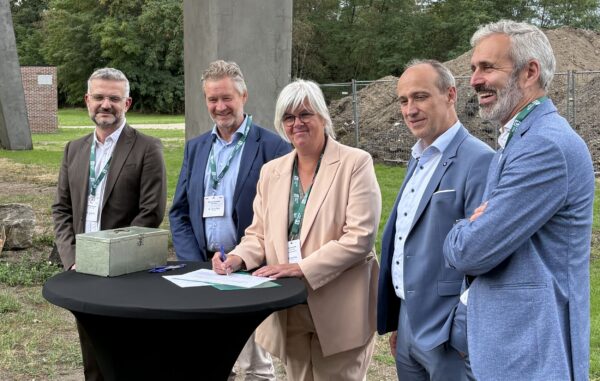
ConstrucThor was developed by an interdisciplinary team from KU Leuven and is part of the Open Thor Living Lab, in close collaboration with EnergyVille. The official opening takes place in the presence of, among others, Minister-President of the Flemish Government Matthias Diependaele, Mayor of the City of Genk Wim Dries, KU Leuven Vice-Rector Stefaan Vaes and EnergyVille General Manager Bram De Wispelaere.

Testing beyond the laboratory
Where innovative construction solutions are often tested today under highly controlled laboratory conditions, ConstrucThor explicitly starts from the chaotic reality of construction and renovation. Variable weather conditions, existing construction practices and unpredictable user behaviour are deliberately taken into account. This makes the infrastructure particularly relevant for companies seeking to validate their products, systems or concepts prior to large-scale commercialisation.
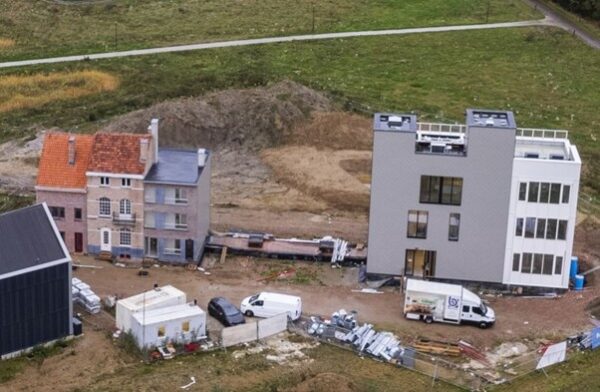
The infrastructure consists of several complementary modules. At its core is a main building whose façade and roof are divided into test zones. Here, companies and researchers can systematically compare a wide range of renovation and new-build solutions under identical conditions.
Adjacent to this is a demountable and adaptable office building in which, across three floors, different floor and ceiling assemblies—ranging from heavy concrete to lightweight timber constructions—are combined. These configurations make it possible to test innovative façade solutions in combination with customised HVAC systems equipped with advanced control technologies.
In addition, the site includes an open construction plot for modular new buildings, and three older buildings that have been reconstructed as realistically as possible. These represent typical buildings found in every Flemish city or municipality and are particularly relevant for the renovation market: a 1930s townhouse, a 1950s semi-detached house and a three-storey apartment building from the 1970s. These buildings incorporate the complex detailing typical of their era and allow sustainable and cost-effective renovation solutions to be tested under realistic conditions. An underground tunnel connects the various modules and houses different climate-neutral heating technologies, enabling flexible testing of new solutions.
Circular by design and inhabited by virtual occupants
ConstrucThor is not only a test facility; it is itself a showcase of circular construction. Wherever possible, materials are sourced from demolished buildings, and the facility is designed for disassembly and reuse. This approach aligns with the growing industrial interest in circular materials, modular building systems and new business models within the construction sector.
The renovation dwellings are also equipped with virtual occupants that simulate building use, such as heating, ventilation, electricity and domestic hot water consumption. Combined with natural climatic fluctuations, this makes it possible to accurately analyse actual energy use, comfort and the lifespan of construction solutions.
From material innovation to integrated energy systems
ConstrucThor enables full-scale testing of a wide range of technologies, from circular and bio-based construction materials to modular and demountable structural systems, with attention to their building-physics performance. In addition, integrated renewable energy technologies can be investigated, such as solar energy, geothermal systems and air-to-water heat pumps, with particular focus on applications in existing buildings.
A platform for collaboration and knowledge sharing
ConstrucThor is conceived as an open innovation infrastructure where research groups, companies from the construction and energy sectors, educational institutions and policymakers can collaborate. The facility provides an independent, scientifically grounded environment to test and compare innovations and substantiate them with measurable data.
As part of the innovation ecosystem of Thor Park in Genk, the infrastructure serves as a crucial link between research, practice and policy. It accelerates the valorisation of new technologies, supports industrial innovation and contributes to a faster and more cost-effective transition towards a more sustainable Flemish building stock.