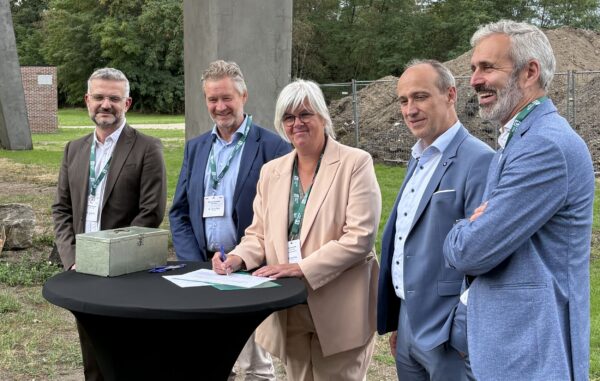
It started the way many growth stories do: with success. HappIT, a software company that has been developing custom solutions since 2013, saw its client base expand while its team evolved alongside it. What began with four people quickly grew into an organization of fourteen colleagues. New projects, more customers, higher expectations.
“Everything was moving forward quickly,” says Merri Schwarz of HappIT. “Maybe even too quickly. We felt we were running into certain limits, but we couldn’t quite put our finger on what was causing them.”
The software was working, customers were satisfied, but internally things were starting to strain. Processes were not always clearly defined, testing was not carried out consistently, and roles and responsibilities were unclear. Issues kept surfacing, but there was a lack of visibility and structure to address them thoroughly.
The Power of an External Perspective
The breakthrough did not come through a drastic decision, but through a conversation on-site. At IncubaThor, where companies work side by side and ideas are exchanged, the name Brightest came up. A software testing specialist with a clear mission: helping organizations build better, more stable software.
“Many organizations know that something isn’t quite right,” says Kevin Pieters. “But they are so immersed in their own operations that it becomes difficult to look at things objectively. That’s where our role comes in.” For HappIT, the first step was a Brightscan. A focused analysis that quickly provided the ideal blueprint for their future growth.

Room for constructive insights
A Brightscan is far more than a superficial review. It is an in-depth exercise in which processes, roles, and ways of working are fully examined. Over a two-week period, Brightest spoke with HappIT employees across the organization. Developers, management, and operational staff all had the opportunity to speak openly. “And that proved to be very enlightening,” says Merri. “Having an external, independent party at the table created a very open and constructive dialogue.”
This fresh perspective brought valuable insights to the surface—insights that can easily be overlooked internally amid the demands of day-to-day operations. It gave HappIT a clear view of how its rapid growth had affected communication, roles and responsibilities, and overall workflow.
That openness produced insights that would have been difficult to uncover internally. Not only were the known issues identified, but hidden sources of friction also came to light. “As a manager, you know what’s happening on the surface,” says David Vandingenen of Brightest. “But the real value lies in discovering the things you don’t yet know. And the only way to uncover them is by listening.”
From Ad-Hoc to Structure
One of the areas HappIT wanted to strengthen was software testing. As is often the case with rapidly growing software companies, testing had previously been something that was fitted in alongside other priorities. “Developers naturally prefer to focus on building,” Merri says candidly. “Without a clear structure in place, testing can easily become something that gets squeezed in at the very end.” Brightest helped introduce the structure that was needed.
Brightest set out to change that. They looked not only at tools, but also at organizational structure: Who is responsible for which role? When does testing take place? How is quality monitored? “Quality is not something that happens at the end of a project,” says David. “It needs to be built into every step of the process.” This philosophy was translated into tangible improvements. Roles were more clearly defined, processes were redesigned, and testing was given a permanent place in the workflow.
Small Changes, Big Impact
What followed was not a dramatic revolution, but a series of targeted improvements. “Simply realizing that there are different ways to approach things makes an enormous difference,” says Merri. “It doesn’t always have to be a major change. Small adjustments often create the biggest impact.” One particularly tangible outcome was HappIT’s decision, based on Brightest’s recommendations, to hire an in-house QA professional—someone fully dedicated to testing and quality assurance.
For Brightest, that is an important sign of success. “Our goal is not to remain indispensable,” they explain. “On the contrary. We want to strengthen companies so they can sustain and manage quality themselves.”

More Than Technical Improvements
The collaboration has taken HappIT’s operations to the next level. Its systems are now even more robust, the infrastructure has been strengthened to support future growth, and there is a greater focus on security.
The new structure is also delivering clear benefits in client interactions, helping the team work more efficiently and provide an even better customer experience.
“We plan more strategically and communicate even more transparently,” Merri says proudly. “Our clients know exactly what to expect. In the past, we would jump straight into action for a client—which reflected our flexibility. Today, we combine that same flexibility with a structured, well-thought-out approach. And that makes us an even stronger partner.”
Growing Together in the Same Ecosystem
The fact that this collaboration emerged is no coincidence. Both companies are part of the same community at Thor Park, specifically within IncubaThor. Here, businesses do not simply work next to each other—they actively engage as part of a shared community. “It’s those small moments that matter,” they say. “A conversation, an introduction, a shared experience. That’s what makes the difference.”
For HappIT, a company that had never placed much emphasis on active networking, the environment proved to be an unexpected advantage. “We now see how many opportunities exist right here on-site. Collaboration and knowledge-sharing happen naturally.”
Brightest shares the same experience. As a testing specialist, the company deliberately positions itself as a complementary partner to the software businesses around it. “We don’t do software development ourselves,” they explain. “That’s exactly why we can provide a strong and independent perspective.”
A Partnership That Continues to Grow
What started as the need to solve a specific challenge evolved into a long-term partnership. Today, HappIT views its operations differently—more structured, more deliberate, and with a clear focus on quality.
“Looking back, that external perspective turned out to be exactly the catalyst we needed to consolidate our growth,” says Merri. “I realize just how much we needed that external perspective. It genuinely helped us move forward.” And the journey is far from over.
Both companies continue to explore new ways to collaborate, learn, and improve. The true result of their partnership is not only more stable software or better processes, but a shared understanding that growth is only truly sustainable when it is supported by quality. And sometimes, asking help from external experts is the best way.